Formerly known as "Creepy-chusetts, Strange-chusetts".
Showing posts with label Hospital. Show all posts

Monday, July 29, 2013

Judi Chamberlin's Political Button Collection -- A Story of a Shrink Resistant Woman

No, anger is not "nice," but it's real, it comes from the gut, and not to be angry at being shit upon is being dead -- which is exactly what shrinks and their kind want us all to become...
But anger is exhausting, and being put down for our anger is destructive. What we need is to be able to turn to one another for strength, for support, and for understanding.
-- From Judi Chamberlain's correspondence, July 19, 1975
Judi Chamberlin at Conference on Human Rights and Psychiatric oppression
Toronto, 1982

You might ask, who's "Judy Chamberlain?" No, you got it wrong, she's Judi. Chamberlin, without an "a." Judi Chamberlain in Somerville removed her name from a phone book because she'd been mistaken over and over again as other Somerville woman named Judi Chamberlin, I mean our Judi.

So why did she collect such quirky pin badges? Shrink resistant, stop shock, what do they mean? Ok, let me tell about her life story.

Shrink Resistant

Sunday, May 5, 2013

Belchertown State School Cemetery, Belchertown (or lengthy thought about myself)

Also read: Belchertown State School
When one of our guys died, all that we'd have would be a graveside service...[T]he way this would be done is that the undertaker, whom I got to know personally, would come up with the body in the limo, and we'd go to the cemetery, and he'd be saying things to me like, "Now Bob, this guy was a nonentity. Let's not take a lot of time." -- An interview to Robert Perske, a former chaplain at the Kansas Neurological Institute.* Italicized by Shuko K.T.
Nonentity, the word stuck in my head forever. Such a disrespectful remark in a solemn scene of a person's death. Why would he say something like that? Were such remarks out of his character, or just a glimpse of an everyday life at an institution?


Tuesday, March 19, 2013

Belchertown State School, Belchertown


The Belchertown State School for the "Feeble-Minded" was established in 1922. The above is a theater with an underground gym where a basketball court and a mini bowling alley left abandoned with icy, squishy floors.

A series of journalistic coverages and lawsuits in the early 70's disclosed the Belchertown's unsanitary, overcrowded condition at some of the dorms where over 80-year-old residents lived with other 120 residents who were "mentally, all two-year-olds in the physical bodies of grown-ups."*  

The school was closed in 1992. A talk of converting the complex into a "5-star living " spa  surfaced in 2006, but even twenty years later, the site remains abandoned.

What is the power that institutionalizes people? Why is such authority dismantled now...or the structures are left derelict, but the system of institution became more invisible and more pervasive? What are the forces that led to the closure of the Belchertown and other countless institutions in the nation; benevolent efforts to place intellectually disabled persons into a community based care, frail of a large scale institutional care, or shift to private enterprise? Where did all the residents go after the closure? Do I know all the answers?

*Robert Hornick, The Girls and Boys of Belchertown. Amherst: U of Mass P, 84.

Locate Belchertown State School @ Google Map

Friday, July 20, 2012

What's on the banner photo?


This is from Medfield State Hospital, the first post I've ever done through the venue called "Creepy-chusetts, Strange-chusetts". It was... about 2 years ago. Medfield State Hospital is a now defunct psychiatric hospital open to public to wander around.

What's the instrument? It looks like for something with music or art therapy. Everything I saw was a great mystery or "discovery" waiting to tell its story. Looking thorough the past pictures, I feel the purpose of my blog (or even my life) is to function as a medium between our everyday life and forgotten or neglected.

I only have 10 days or so in Boston. There are so many places I wanted to visit. Perhaps, I should visit Danvers State Hospital and its cemetery again.

Tuesday, May 15, 2012

Hillcrest Cemetery (Grafton S. H. Cemetery), Shrewsbury 2-2

From Hillcrest Cemetery, Shrewsbury 1-2


So, why is there an abandoned tower in the state hospital cemetery property? There is an interesting discussion about the original purpose of the tower speculating it was: a Civil War era watching tower, Irish tower commemorating Irish immigrants held in the hospital, water tower for the hospital, etc.

Monday, May 14, 2012

Hillcrest Cemetery (Grafton S. H. Cemetery), Shrewsbury 1-2

From Grafton State Hospital, Grafton


After visiting the former Grafton State Hospital, I dropped by Hillcrest Cemetery where approximately 1,041 male and female patients held at Grafton State Hospital are buried. Their identities are only distinguished by the numbers on austere concrete blocks.

There is always a mystery in Massachusetts woods. A state hospital on the hillside and its hidden graveyard are some of those mysteries. Even the residents would not imagine there is a graveyard in their backyard, but the local teenagers find it anyway; they seem to be strangely fascinated by those numbered gravestones.

Hillcrest Cemetery has one of those Massachusetts mysteries, but there is a further puzzlement that nobody knows for sure.


Monday, April 30, 2012

Grafton State Hospital, Grafton


Grafton State Hospital was established in 1901 as a farm colony of Worcester State Hospital.  Worcester was the oldest state hospital opened in 1830, and their expansion reflected  a mandate passed in 1900 that state has the responsibility to take care of its indigent insane. A massive influx of patients from town and city level institutions was expected; prior to the mandate, a local poorhouse was the destination for the those who were less fortunate.

Tuesday, November 29, 2011

Bridewater State Hopital Cemetery 2-2, Bridgewater

From: Bridgewater State Hospital Cemetery 1-2, Bridgewater

From Titicut Follies (1967)

I visited Bridgewater State Hospital Cemetery to connect a patient -- who is coffined in the above picture -- and one of the 346 nameless, numbered gravestones in the cemetery.

Together with the cemetery, Bridgewater State Hospital was established in 1850's as a state run almshouse. Currently, the hospital is functioning as a medium security correctional facility.

Friday, November 11, 2011

Bridgewater State Hospital Cemetery 1-2, Bridgewater


I went to Bridgewater State Hospital Cemetery for a specific reason. I wanted to connect one patient's story -- how he was treated in the hospital, the way he died, and how he was buried -- and a nameless gravestone. His gravestone is one of the numerous numbered gravestones in Massachusetts; I hoped to find what kind of life story could be found from those numbered concrete blocks. 

Sunday, August 28, 2011

Examining the Cambridge Poor Farm 2-2

If you stumble upon this post, I'd recommend reading Examining the Cambridge Poor Farm 1-2 first.

It dawned on me that I would have ended up there. Cerebral shunts weren’t even invented until the late 1800′s and probably not even remotely safe for most patients until the 1900′s...Eventually I would be considered invalid, and with no source of income I would be sent to the Poor Farm. Maybe I would do some light quarry work or net some fish, but more likely I would spend my days moaning in pain on a dirty floor while the orphans try to avoid me or steal my food. -- From Baron Barometer's Brain Blog 

Cambridge Poor Farm

Located on the most northern corner of the city of Cambridge, the Cambridge Poor Farm was established in 1851. At the almshouse, "the elderly and 'the deserving poor' lived among the sick and the insane" until its closure in 1927.

Continuing from the previous post, I've been investigating this less known piece of Cambridge history together with the 1851 Cambridge Chronicle article. What intrigues me the most is that how the historic event, philosophy, and public sentiment of the time reflected the walls of those institutions. Now, I'll continue the virtual tour. Let's go to 3rd floor.

Monday, August 22, 2011

Examining the Cambridge Poor Farm 1-2

Wow, time flies. I started my blog "Creepy-chusetts, Strange-chusetts" on August 24, 2010. A year ago, I had little connection with Massachusetts. I knew nobody, I knew nothing about the place! I started the blog hoping to know people in my neighborhood and learn about this tremendously interesting state. The result? It has been great. The idea for my blog is still bottomless, and I hope I can continue my "quirky" adventure further. I thank all the readers and people I became to know through my investigation.

Today, I'd like to introduce what I found through my little research about an ex-almshouse in my neighborhood. Together with Gaebler Children's Center in Waltham, this is one of the most memorable places for me because I became to know some fabulous people though the investigation. -- Shuko K.

Then: from Cambridge Chronicle Mar. 22, 1851
Now: Aug., 2011

Sunday, June 26, 2011

Tewksbury State Hospital Cemetery, Tewksbury

Continue from: Stonecroft @ Tewksbury Hospital, Tewksbury


There are two cemeteries for Tewksbury State Hospital. The one I visited is called "the Pines Cemetery". The other is simply called "the Pauper Cemetery". They are located in separate woodlands nearby the hospital. According to the Public Health Museum, approximately 15,000 patients, who had no relatives claimed their bodies, are buried in those no-name cemeteries. Apparently, the records between 1854 and 1894 are missing, but at least the patients deceased between1891 and 1930 are buried in the Pines Cemetery. In the Pauper Cemetery, the burials took place as late as 1960's.

Established in 1892, Tewksbury Hospital was originally called as the Tewksbury Almshouse. Many of them were destitute immigrants notably from Ireland. In addition to the poor, they accepted the "pauper insane", alcoholics, and patients with such contagious disease as TB.

Saturday, June 18, 2011

Stonecroft, Tewksbury

Reminder: Stonecroft sits in the middle of an active hospital property. Please respect hospital workers and patients and do not disturb the property.

Continue from Tewksbury Hospital, Tewksbury

Conditions at the Tewksbury Almshouse were deplorable. Chronically underfunded, overcrowded and in disrepair, the Almshouse housed an average of 940 men, women and children during the years that Sullivan was there. The mortality rate was very high, and within three months of their arrival, Jimmie Sullivan died. --From Perkins School for the Blind

Stonecroft, Rear

Saturday, June 11, 2011

Tewksbury Hospital, Tewksbury

Old Administration Building, built 1894

Tewksbury Hospital was one of the state run almshouses established in 1852. The Bridgewater, Monson and Tewksbury Almshouse were opened to accommodate an increasing number of destitute immigrants in Massachusetts.

The Bridgewater Almshouse later become a correctional facility for "criminally insane", and Monson became "Massachusetts Hospital for Epileptics" in 1895. Tewksbury began accepting "pauper insane" in 1866. Alcoholics were treated in the course of expansion. The almshouse/ asylum also admitted patients with such contagious disease as TB, small pox and typhoid, but also remained as an almshouse, especially during the time of the Great Depression.

Sunday, June 5, 2011

Stuck in the Emerson Iron Lung

(a follow up of: Emerson's Iron Lung and Quonset Hut, Cambridge)


Recently, I visited the Public Health Museum at Tewsksbury Hospital and came across an object I mentioned in my past post.

I live close to the former main office of J.H. Emerson Co. in North Cambridge. The company was the leading manufacture of a negative pressure ventilator a.k.a Iron Lung during the polio outbreaks between the 40's and 50's. It was a temporal measure for the majority of the patients, but some remained to rely on an Iron Lung permanently.

Saturday, May 14, 2011

Foxborough State Hospital Cemetery II, Foxborough

From Foxborough State Hospital Cemetery

This cemetery was created in 1933 and subsequently expanded that those who remained in the state care even in death would have the dignity of a proper burial. -- Foxborough State Hospital Cemetery
Are we mental patients even in death? Why does the state hide our names? "It has been said that no families have come forward to claim their relatives buried in these cemeteries. WE are their families!" Mark Giles, ex-patient and activist. -- National Empowerment Center


About a month ago, I visited the former Foxborough (or Foxboro) State Hospital and its cemetery. The hospital was established as the Massachusetts Hospital for Dipsomaniacs and Inebriates in 1889. By 1914, the inebriate hospital was transformed to a psychiatric hospital. In 1976, the Foxborough closed its door and was converted to a condo in 2009.

Saturday, April 16, 2011

Foxborough State Hospital Cemetery, Foxborough

Continue from Foxborough State Hospital

As needs increased in the Great Depression, this cemetery was created in 1933 and subsequently expanded that those who remained in the state care even in death would have the dignity of a proper burial. -- Foxborough State Hospital Cemetery


After visiting the Foxborough State Hospital -- a former psychiatric hospital now converted to a condo -- I headed to the Foxborough State Cemetery. Located 0.8 mile (1.3km) apart from the hospital, it is in a quiet but moderately populated residential area on Cross Road. A robin was tottering on the property; indeed a rare sight to see. Because I usually experience a complete silence detached from the surrounding environment in a state hospital cemetery. But this cemetery felt less isolated than the other.


Apparently, there are two cemeteries in different locations. The one I visited is more accessible; the other is "about 125 yards up into the woods" (from Asylum Project.) I wanted to visit the other site, but there was little clue available. If you know about the other location, I would greatly appreciate your tip. As I always do, I'll visit the cemetery with a flower bouquet.

Up in this woods?

This cemetery was created in 1933. Approximately 1,100 former patients are buried in the locations. The state originally purchased plots in Rock Hill Cemetery in Foxborough, but the arrival of the Great Depression meant the increase in deceased patients who had no families claimed the bodies and provided plots for them.

It is sadly striking that the correlation between the patient number and the gravity of the economic depression. I cannot help wondering about how the recent financial crisis circa 2007 affects our mental health. At least, it hasn't been the easiest period for an immigrant like me.


Each state hospital cemeteries in Massachusetts has its own system in numbering the deceased. For example, Metfern Cemetery in Waltham (a final resting place for some of the patients in the Metropolitan State Hospital and Fernald State School) sorts gravestones by religion: a gravestone inscribed as "C + number" meant the deceased was a Catholic, and "P + number" was a Protestant.

The Foxborough has two sets of number in one gravestone. For example, the face of one certain gravestone is inscribed with 5 digit number (i.e. 12537), and the other side has 3 digit number (i.e. 278). According to Asylum Projects, the 5 digit number indicates the patient ID number, and the 3 digit indicates the order of burials took place. Please examine the following pictures:

Patient Number 12537
Patient 12537 was 278th in burial

The cemetery claims that "those who remained in the state care even in death would have the dignity of a proper burial." What is their definition of a "proper burial", I thought. Doesn't a proper burial mean providing a gravestone with his name, the date of birth and the date of death? Even if the hospital couldn't find a patient's name and the date of birth, they could at least provide the date of death. I'm not sure whether providing "John Doe" with DOD would constitute a burial with dignity, but I do not think gravestones with numbers only constitute my definition of a proper burial.

On the other hand, the case with the Northampton State Hospital in Northampton, MA is an absolute history of neglect. The detail of burial is uncertain because the records have been missing or stolen; there is even  a possibility no one with authority tried to document ! The burial site for the Northampton is currently used as a hey field owned by the Department of Food and Agriculture.

However, as with the case of some state hospital cemeteries in Massachusetts, it is possible to recollect the documents and accompany new gravestones with names at the Foxborough; there was no single gravestone with a name at the cemetery.


R.I.P.

Continue to Foxborough State Hospital Cemetery II

Locate Foxborough State Hospital Cemetery @ Google Map

Click picture to enlarge

Foxboro State Hospital, Asylum Projects: http://www.asylumprojects.org/index.php?title=Foxboro_State_Hospital
A brief history of the burial site, NSH Burial Site Project: http://users.rcn.com/tclement/NSH/History.html

Thursday, April 14, 2011

Foxborough State Hospital, Foxborough


The predecessor of the Foxborough State Hospital, the Massachusetts Hospital for Dipsomaniacs and Inebriates was established in 1889 to retreat and cure alcoholics. Did the society regard those who succumbed to alcoholism as the casualty, sinner, lunatic or criminal? That was the first question when I saw this antiquated hospital name.

Located 20 mile (32km) south of Boston, the town of Foxborough now hosts the stadium for the New England Patriots. Driving through cranberry bogs looked like blood pools, the marshlands reminded me that it was getting close to the infamous Bridgewater Triangle.


After 1905, the Massachusetts Hospital for Dipsomaniacs and Inebriates went through a gradual transition to a psychiatric institution. By 1914, all the alcoholic patients were transferred to the Pondville State Hospital (aka the Norfolk State Hospital), some 50 mile southeast of Foxborough. And the inebriate hospital in Foxborough became the Foxborough State Hospital.

After less than 10 years of operation as a hospital specialized in alcoholism (and drug addiction), the Pondville was under the influence of history. The aftermath of World War I had affected American society; the federal government took over the hospital in 1918 to treat soldiers with PTSD related mental problems.


The Massachusetts Hospital for Dipsomaniacs and Inebriates was constituted with a few isolated wards. After the transition to the Foxborough State Hospital, the building blocks were connected by hallways functioned as day rooms. In addition, numerous isolated buildings and facilities such as coal generated power plant, laundry, staff housing, sewage treatment plant, and TB sanatorium dotted the campus.

When did Andy and Mandy inscribe their love to a tree trunk?

In 1976, the Foxborough closed its door. After the hospital functioned as various government related facilities and an annual Halloween horror house, it was finally converted to a condo in 2009.

It was an early spring, but the turf on the condo property was bright green, signifying the comfortable and aesthetically pleasing American ideal. Well, this is the nice side of the former hospital; the backside is a barren, bleak space that its future could well be in oblivion in few years time.


Now I ask you the question I had in the beginning: did the society in the early 20th century regard those who succumbed to alcoholism as the casualty, sinner, lunatic or criminal? Why did the state establish a hospital specialized in alcoholism?

The purpose of such hospitals as the Pondville State Hospital was "to provide hospital treatment for 'hopeful' cases and a detention colony for noncriminal but chronic cases." (from Asylum Projects) I hope the former function was the main focus of such institutions, but as with the case of asylums back then, the main purpose of such institutions was geographically externalizing the certain segment of society from the rest.

Railroads in American society often function dividing one community to the other 

But why did the state built such a grandiose redbrick to show the public that this would be the end result if you succumb to intoxication? Sure, so many families have been destroyed by family members' drinking problem, and many have lost their lives from poising themselves; I really hate to see that.

First thought I came up with was the rise of the prohibition movement in the mid 19th century that eventually lead to the enactment of the Volstead Act of 1919. The Prohibition Movement was backed up by some denominations of Protestant churches claimed drinking as the evil leads to immorality and sin. This was the beginning of the Roaring Twenties.


But there is more systematic, calculative rationalistic tone under the redbrick. I remembered the tragic stories of unwed mothers in the 20's confined into asylums in England, labeled as a societal threat that weakens the nation's strength with their "deviant" genes (please refer to my post: Our Lady's Hospital, Cork, Ireland.)

What were deemed as "deviant genes"? Eugenics was the scientific, rational answer to the question in the early 20th century. In May, 1911 a special committee was formed under the eugenics section of the American Breeders Association. Consisted with an advisory panel whose expertise in such studies as law, medicine, psychiatry, and social and political sciences, the main purpose of the committee was  to identify and sterilize groups of people who would "contaminate" the American population with their "inferior" genes. Two months after the formation of the committee, a series of conferences were held in an exclusive New York club in order to purify the American blood:
Ten groups were eventually  identified as "socially unfit" and targeted for "elimination". First, the feebleminded; second, the pauper class; third, the inebriate class or alcoholics; fourth, criminals of all descriptions including petty criminals and those jailed for nonpayment of fines; fifth, epileptics; sixth, the insane; seventh, the constitutionally weak class; eighth, those predisposed to specific diseases; ninth, the deformed; tenth, those with defective sense of organs, that is, the deaf, blind and mute. -- from War Against the Weak by Edwin Black, italicized by S.K.


1911 was the period when the Foxborough was transitioning from an inebriate hospital to a psychiatric hospital, transferring its alcoholic patients to the newly established Pondville State Hospital. The increasing number of asylums indicates the burgeoning idea of Eugenics was taking shape as the redbirck architecture, symbolizing the measure of isolating the "socially unfit" for the sake of eventual "elimination".

You may think "Thank god, such an absurd, cold-heated notion is now gone! No wonder why those asylums are now abandoned." Well, I don't want to say much about, but think about this "Economic Darwinian" society we are in...


How long is this abandoned wheelchair sit on this spot? This isn't a kind of wheelchair that one can play basketball with; this thought made me sad. And how many times would I encounter the notion of Eugenics when I look at those redbricks?


I came across a chapel of which annex roof was totally caved in. It looked like it would be demolished any time soon. Some of the windows were broken and even not boarded. I peeped through one of the openings to see the interior.What was the function of this space?

A young woman with her cell phone, chatting about her everyday life passed behind of me while I was completely absorbed by the sight of the ruin. She probably lives in the condo. The contrast between her everyday life and the surreal sight of the abandoned interior space was begging to provoke some existential questions about the ephemeral nature of people's memory.

Abandoned interior of FSH Chapel
From "Memory" by Serghei Minenok

"Memory" is a five minutes documentary about a movie director, Andrei Tarkovsky's childhood home in Moscow. While it was directed by Serghei Minenok in 1997, the filming style and spatial sense honor Tarkovsky's movies represented by Stalker*.

*Plot summary: a guide called the Stalker brings two clients to the abandoned area called the Zone that is heavily guarded by the government. The objective of their trip to the Zone is reaching "the Room" because the space is rumored to embody the visitor's deepest desire. The Zone is often compared to the area surrounding Chernobyl nuclear powerplant of which disaster took place 7 years after the movie was made.  


What striking about the documentary is the stark contrast between the completely ruined Tarkovsky's house and the everyday life of a busy Moscow street where cars constantly pass by. While his house symbolizes a wet, bleak space like the forbidden Zone in Stalker, the outside is an ordinary post-Soviet Moscow. 

From "Memory" by Serghei Minenok
FSH Chapel, from Google Map

There is an interesting similarity between the abandoned Chapel and Tarkovsky's home. At the Foxborough, the residents park their car around the ruin and conduct everyday tasks like unloading grocery and chatting on a cell phone. The intense history of the chapel and hospital becomes obscure by everyday life and will be forgotten from our memory, waiting to be swallowed by the surrounding environment like the Tarkovsky's childhood home was destined to be.


Continue to Foxborough State Hospital Cemetery

Locate Foxborough State Hospital @ Google Map

War Against the Weak by Edwin Black
Asylum Projects: Foxboro State Hospital
Asylum Projects: Pondville State Hospital
Opacity: Foxboro State Hospital

Stalker directed by Andrei Tarkovsky (1979)

Monday, February 28, 2011

Gaebler Children's Center, Waltham

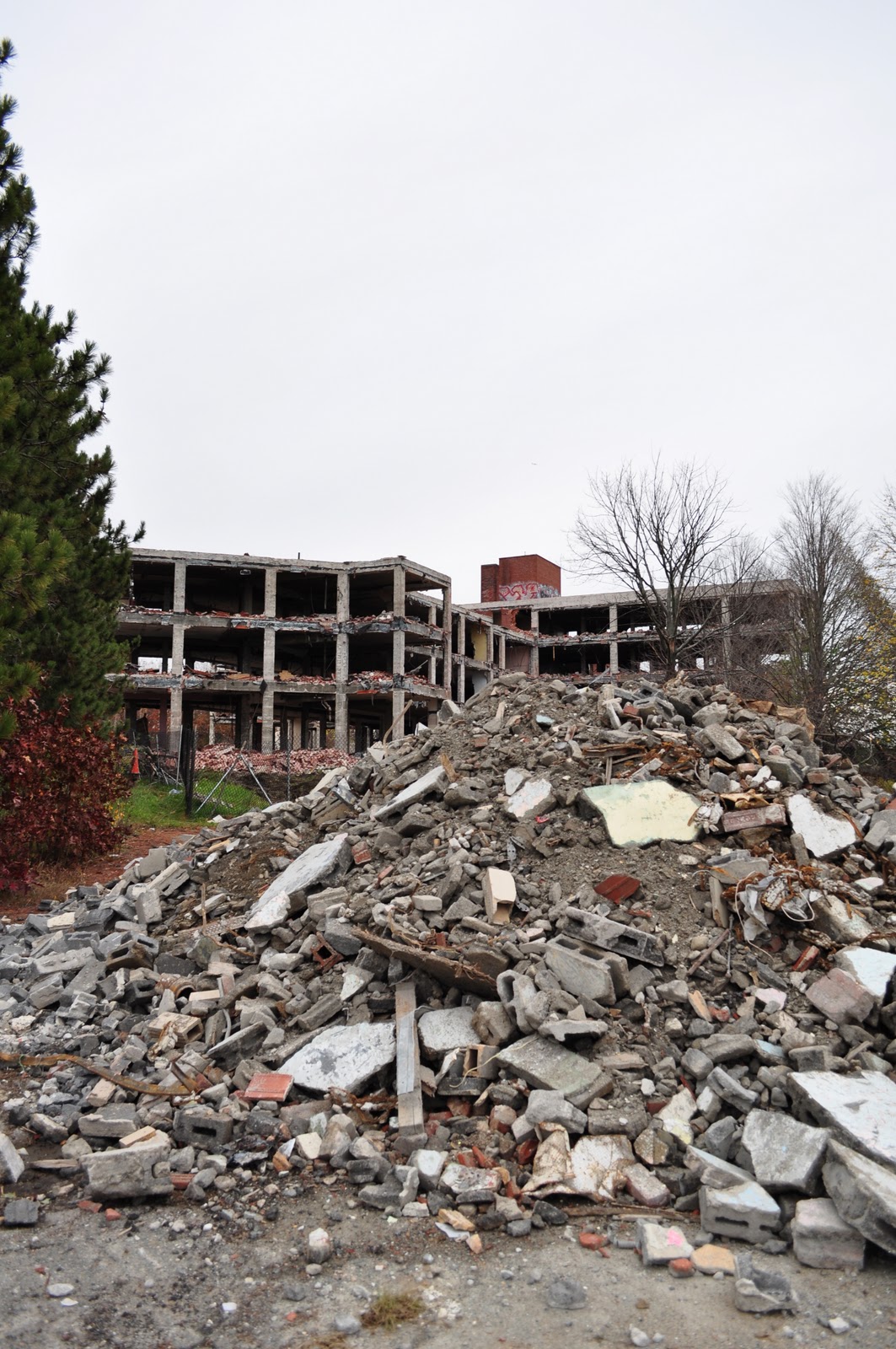
(Pictures are taken in two days to show how demolition progressed)


Not telling what happened in Gaebler Children's Center is worse than not being willing to know or forgetting what happened in the Waltham forest. I have been hesitant to disclose the story. Together with pictures I took, I was considering keeping the story just in my memory. But you have shared a fraction of experience of the red brick, but you chose not to tell? Like many Atomic Bomb survivors in Hiroshima and Nagasaki don't want to remember and tell their experience, it is understandable that some of the ex-students are not willing to tell their experience. Some past is too painful to remember. Some past is regarded as the best not to talk about to avoid troubles. That’s not what I’m talking about.

As an outsider, I don't bear the burden many students may have. I have to have guts to tell a story of a woman who spent two years inside of the red brick. I hope sharing a little piece of information I gained through the conversation helps understanding and remembering what happened in the recently demolished psychiatric hospital for children.


Located nearby Metropolitan State Hospital (a public psychiatric hospital for adults, now a condo), Gaebler Children's Center in Waltham, MA was established in 1955 as a state psychiatric hospital the patients between 6 and 18 years old. The center was closed in 1992 and left abandoned for 18 years. The demolition project was finished in the late November, 2010.


On one cold, gray autumn afternoon, I was exploring the nature path in Waltham. The demolition project was almost finished. As I passed by a couple, we greeted. Like people say hello to each other in the woods.

"Quite a sight, isn't it?" 

Looking over the 1939 Warsaw like red brick building, our conversation naturally went to Gaebler. They asked me whether I'm from a newspaper company. I told them I'm a blogging person. After carefully examining my camera and face looking at the ruin, the woman said:

“I used to be there.”

It was surprising. But what soon came up to my mind was the cross at Metfern cemetery, a final resting place for some of the patients for Metropolitan and Fernald State School between 1947 and 1979. Dedicated by the former Gaebler children, the cross was accompanied with a very thoughtful note: Though your names are not known, Your lives will never be forgotten...


I was very curious about her life in Gaebler. While I anticipated the possibility of her hesitance telling the story to a complete stranger like me, she started talking about her experience in a quite open manner. But facing the building which would cease its existence quite soon, there was a tone of fervent obligation in her voice. The skeletal state of the building seemed to bring lucid memories back to her as well.


After the closure in 1992, the building had been boarded up to prevent trespassing. But while demolition was going on, the boards were removed, revealing the interior that only a few knew before. She pointed out an interior of a room visible from us.

“Do you see the room with a rainbow?”

“Yeah…”

“That was my room.”


It was as if she was reading my thought; I was obsessing about the rainbow room since I had noticed the painting a month ago. I was imaging what if I had been involuntarily sent to Gaebler and stuck in a room with such a "cheerful" painting. It would get on my nerve if adults thought I could be appeased by a fake rainbow. 

My mind was spinning like a doped-up hamster on a wheel, but what I did was lamely keeping a straight face to her. It was very Japanese movement of me, but why didn't I tell her? Because compared to her experience, my casual daydreaming is nothing.  


After introducing her room, she described her experience.

She spent two years in the institution in the early 80's. It was a hellish two years, it was virtually a prison or worse for her and other kids. She built many lasting friendships which helped her to get through, but the bad memory exceeds the good one with friends.

As a teenager girl, her mother's illness took a heavy toll on her. The stress coping mechanism was still developing, and she had a difficulty manifesting her anxiety and anger. The adults surrounding her were also upset by her mother's illness, and it was beyond their capacity to take care of her. That was how she was sent to Gaebler. She still questions their decision. And this is the question she has no choice but keeping tackling for the rest of her life.

Now married to an understanding husband, she firmly told me that she will not let her children experience the same, no matter what happens. I admire her strength to reflect her experience to such a positive, genuine determination. But not every children of Gaebler has the life path like her.


Every movement was restricted while she was in Gaebler. For example, she needed to go through a lengthy procedure to take a shower, even though her rainbow room was right next to the shower room. Once she was in the shower room, alone, they locked her in from outside. A simple act of taking a shower (and a vital act for a teenager girl!) becomes an enduring task.

There was no AC available. The 1955 building filled with asbestos would have been an awful place to spend a summer. Opening the windows wasn't an option; the children had no control over windows. It's such a basic, basic act that I never thought twice about when I was a teenager. Somehow I'm very particular with windows and I would go nuts if I was told I couldn't open windows by myself; I'm aware that people who engage with psychiatric care may think I'm naive, but for that specific reason, if I was sent to Gaebler, I wouldn't recover well...

Together with a tiny playground, there used to be a pool in the property. But the pool was regarded as a privilege only available for “good kids”. So "bad kids" blankly stared at the good ones in the pool from a stifling room with possibly closed windows. I'm no expert in psychiatric care, but I can see the pool activity may be restricted as safety measure. On the other hand, I can clearly say such a punitive use of privileges is not a treatment. She didn't particularly mention, but the facility was possibly overcrowded. Many staff could have been overwhelmed, and had little capacity to control the situation in order to recover the kids to society.


They used to sedate her with antihistamines. My understanding of the medicine is as an allergy reliever... Added Mar. 5: In addition to Benadryl, the staff gave children Thorazine and Valium. If the children were psychotic or suicidal, or if they were simply deemed as disobedient, they tied them up and put into the 2x2 seclusion room. The fear of being dumped into the space loomed like 1984's Room 101. Like a random dice game, there was a little predictability of the possibility of being kept in the room:
the staff at Gaebler through the use of seclusion, kept us in fear and a constant double bind. Apparently there was no clearly defined or enforced policy to guide and prohibit the use of it...Seclusion and the threat of it empowered the staff as the absolute authority. One could never be sure when or how it would be utilized by them. -- From Gaebler, Hell and Back by Andrew Palmer
Literally across Trapelo Road, an identical fear had been prevailing at Fernald School, a state run institution for children with developmental disability. According to M. D'Antonio's The State Boys Rebellion, Ward 22* was the Fernald boys' seclusion room during the 50's. However, from what I read from Alex Beam's Gracefully Insane, the patients at nearby McLean Hospital -- a privately run psychiatric hospital of which campus is landscaped by Fredrick Law Olmsted -- did not experience the identical treatment.

*the misuse of Ward 22 was rampant during the 50's due to the overcrowding and increase in the number of mismatched boys institutionalized due to learning disabilities and/or the lack of proper prior education. 


However, there is one similarity between McLean Hospital and such a state institution; underground tunnels. When McLean was planning to build a new campus in Belmont in the end of the 19th century, the idea of connecting separated wards and other buildings by underground tunnels was proposed by Olmsted and his partner Calvert Vaux. The ones in Danvers State Hospital were made infamous by the movie Session 9, but passages in McLean are less known.

No name gravestone at Metfern Cemetery

She told me Metropolitan State Hospital and Gaebler are connected by underground tunnels. The distance between the two is about 0.6 mile (1km) with steep hills. I wonder why they needed to connect the two; doctors and nurses in double shifts? But I couldn't help thinking about the possibility of the tunnel being used to carry the deceased from Metropolitan to Metfern Cemetery. The cemetery is only 0.1 mile (200m) apart from Gaebler. More than 300 patients are buried in the cemetery, but  there is no paved road access to get there; just narrow, hilly dirt trails in the woods. Things wouldn't have been awfully different when the cemetery was active.

Note: now you should wonder how close together those institutions are; check out my map...  


“You know what?” she said.

"When I was locked up there, the world seemed so small. But now I see the walls are removed, it is such a huge building. When I was there, it never occurred to me…”

The walls she banged so many times are now removed.

“Ha, nobody will hear you!" the stuff used to yell at her when she was banging the wall.

Indeed, the walls were well insulated. But there was a certain room she constantly heard banging and screaming noise. She thought she must have been hallucinating, but her friends also heard the same.


Eventually, a series of law suits during the 80's helped improve the condition at Gaebler.

She thinks back to the pre law suit time, “Back then, they didn’t know how to treat kids with problems. They simply locked them up.”

I asked her a question, “You said they drugged the kids to shut them up, not to treat them. Do you think other kind of treatment, like counseling, would have helped you and other kids?”

“No, I don’t think so. There were counselors, and we supposed to talk to them. It didn't help me.”

 I questioned her about the counselors because Andrew Palmer's depiction of counselors as authoritarian, cruel figures didn't match my stereotypical image of gentle, patient, and warm listeners, say kinda hippie type. At Gaebler, everything was upside down.

Possible asbestos removal gears on the trail

The town considered converting the school into other uses, but it appeared so much asbestos was contained that it proved too costly to rehabilitate the building. The contractor spent quite a time in removing asbestos before knocking down the building. She emailed the town inquiring the future of the building; she's still waiting for the reply.

She is basically happy to see the building is on the process of demolition; this is the place she spent two hell years, the experience that she would never be able to shake off from her memory. On the other hand, she is afraid that the demolition also means people are forgetting, or actively trying to erase the memory about the children of Gaebler. Demolishing a building is dead easy, but irreversible. She wanted the building converted to something rather than destroying it. I asked,

"What kind of conversion did you wish, like the condos they turned Metropolitan State Hospital into, or maybe a museum about the school?"

"No, I wanted the building converted to something like a school...a school for kids..."


The blazed site will be the part of the existing nature trail. No more mystery in the woods. No more creepy off limits. No more nuisance. Out of sight, out of mind.


Locate the site of Gaebler Children's Center @ Google Map

Gaebler, Hell and Back and his observation about writing the story by Andrew Palmer (based on his experience at Gaebler in the mid 70's.), and the response to his story by a former Gaebler counselor.
Gaebler Children's Center @ Opacity
State Boys Rebellion by  Michael D'Antonio
Gracefully Insane by Alex Beam


About demolition:
http://www.wickedlocal.com/waltham/features/x290095825/Demolition-begins-on-Walthams-58-year-old-Gaebler-School
http://blogs.wickedlocal.com/brandnewwatch/2010/12/02/visual-update-on-the-gaebler-school-demolition/