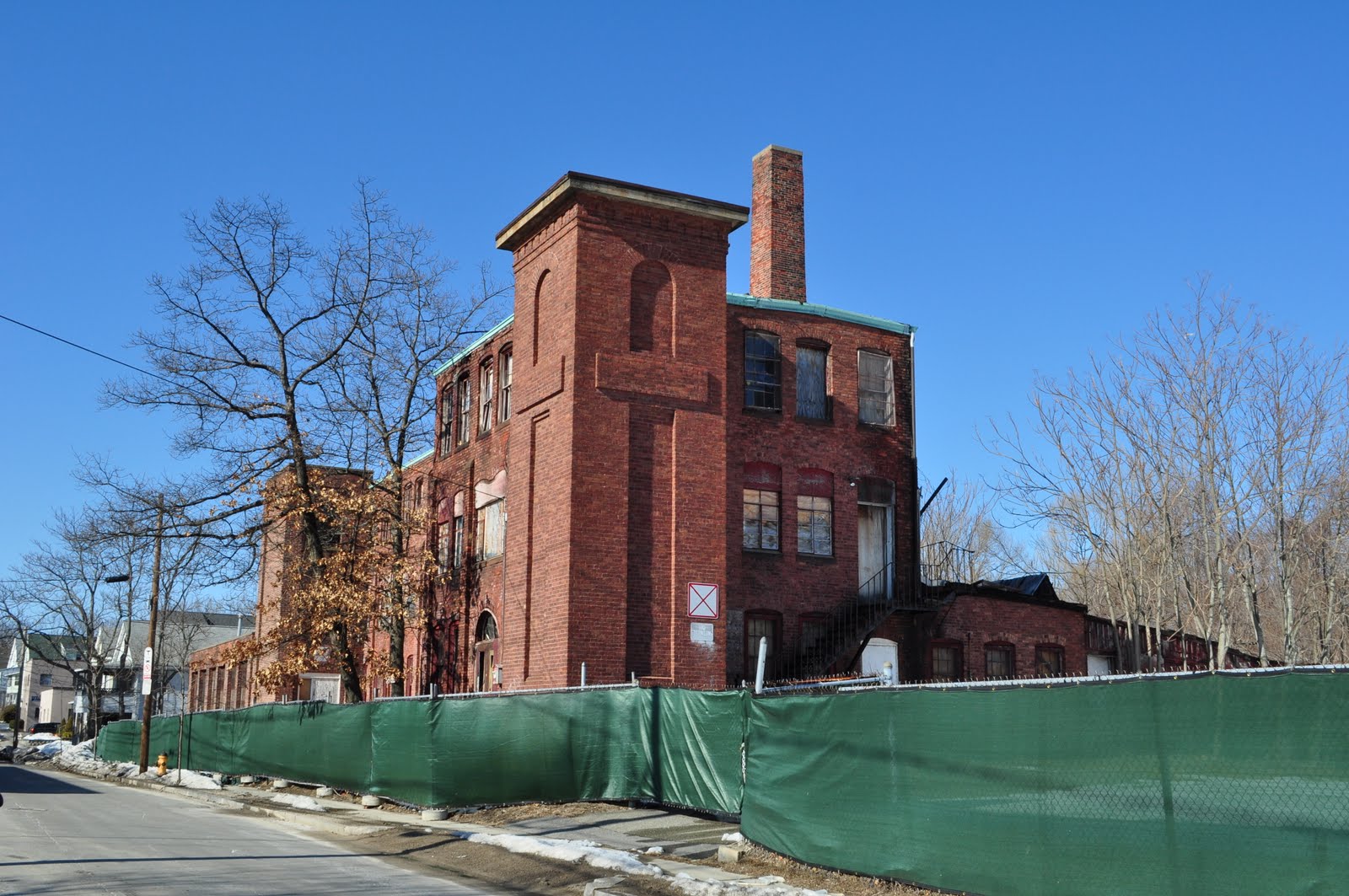
Formerly known as "Creepy-chusetts, Strange-chusetts".
Monday, April 25, 2011
Wachusett Dam, Clinton
One very cold and windy day in the late February, I went to the Old Stone Church in West Boylston. The abandoned but well preserved church on the bank of the Wachusett Reservoir is a few remnants from the period before the arrival of the Wachusett Dam. On that day, I really wanted to visit other reservoir related structures, alas it was way tooooo cold.
I had waited until spring comes; on one sunny and warm day in March, I finally went to the Wachusett dam, the Clinton Tunnel, and the Wachusett Aqueduct. First, I'll show you the Wachusett Dam.
The construction of the dam began in 1897 and completed in 1905 (the plaque at the dam says it was in 1906.) Communities along the Nashua River in the towns of Boylston, Clinton, Sterling, and West Boylston were impounded and the dam was filled in 1908 to provide water for the growing, thirsty metropolis.
At the time of the completion, this public reservoir with 21mile (34km) shore length was the world biggest of the kind. Though the completion of the Quabbin Reservoir in 1939 meant the Wachusett to be relegated to the second.
Immigrant workers were hailed from Italy. Today, many descendants of the workers reside in the area. And look, the stone arch above is still looking study and beautiful even 100 years later.
Ok, let's head to the Clinton Tunnel. I was really exited about the tunnel and wanted to go as soon as possible. But...look at the steps in the below photo. As I was climbing up the stone steps, I remembered why I hate running; it's exactly the feeling of being drowned. My throat began to taste like blood... I'm awfully out of shape.
I've heard some people experience the Clinton Tunnel stretches while they are exploring inside of the tunnel. But I refute; the steps are the paranormal object that stretches!
I sat down on the lawn leaving only 20 steps to go. That damn 20 steps... I drank water and realized why my mouth tasted like blood; ughhh I bit myself.
What are those stone foundations in the water? The answer is in next post: Clinton Tunnel, Clinton. Here's a hint:
Locate Wachusett Dam @ Google Map
West Boylston Historical Society: http://www.wbhistory.org/history.htm
History: Wachusett: http://www.mwra.state.ma.us/04water/html/hist4.htm
Saturday, April 16, 2011
Foxborough State Hospital Cemetery, Foxborough
Continue from Foxborough State Hospital
After visiting the Foxborough State Hospital -- a former psychiatric hospital now converted to a condo -- I headed to the Foxborough State Cemetery. Located 0.8 mile (1.3km) apart from the hospital, it is in a quiet but moderately populated residential area on Cross Road. A robin was tottering on the property; indeed a rare sight to see. Because I usually experience a complete silence detached from the surrounding environment in a state hospital cemetery. But this cemetery felt less isolated than the other.
Apparently, there are two cemeteries in different locations. The one I visited is more accessible; the other is "about 125 yards up into the woods" (from Asylum Project.) I wanted to visit the other site, but there was little clue available. If you know about the other location, I would greatly appreciate your tip. As I always do, I'll visit the cemetery with a flower bouquet.
This cemetery was created in 1933. Approximately 1,100 former patients are buried in the locations. The state originally purchased plots in Rock Hill Cemetery in Foxborough, but the arrival of the Great Depression meant the increase in deceased patients who had no families claimed the bodies and provided plots for them.
It is sadly striking that the correlation between the patient number and the gravity of the economic depression. I cannot help wondering about how the recent financial crisis circa 2007 affects our mental health. At least, it hasn't been the easiest period for an immigrant like me.
Each state hospital cemeteries in Massachusetts has its own system in numbering the deceased. For example, Metfern Cemetery in Waltham (a final resting place for some of the patients in the Metropolitan State Hospital and Fernald State School) sorts gravestones by religion: a gravestone inscribed as "C + number" meant the deceased was a Catholic, and "P + number" was a Protestant.
The Foxborough has two sets of number in one gravestone. For example, the face of one certain gravestone is inscribed with 5 digit number (i.e. 12537), and the other side has 3 digit number (i.e. 278). According to Asylum Projects, the 5 digit number indicates the patient ID number, and the 3 digit indicates the order of burials took place. Please examine the following pictures:
The cemetery claims that "those who remained in the state care even in death would have the dignity of a proper burial." What is their definition of a "proper burial", I thought. Doesn't a proper burial mean providing a gravestone with his name, the date of birth and the date of death? Even if the hospital couldn't find a patient's name and the date of birth, they could at least provide the date of death. I'm not sure whether providing "John Doe" with DOD would constitute a burial with dignity, but I do not think gravestones with numbers only constitute my definition of a proper burial.
On the other hand, the case with the Northampton State Hospital in Northampton, MA is an absolute history of neglect. The detail of burial is uncertain because the records have been missing or stolen; there is even a possibility no one with authority tried to document ! The burial site for the Northampton is currently used as a hey field owned by the Department of Food and Agriculture.
However, as with the case of some state hospital cemeteries in Massachusetts, it is possible to recollect the documents and accompany new gravestones with names at the Foxborough; there was no single gravestone with a name at the cemetery.
R.I.P.
Continue to Foxborough State Hospital Cemetery II
Locate Foxborough State Hospital Cemetery @ Google Map
Foxboro State Hospital, Asylum Projects: http://www.asylumprojects.org/index.php?title=Foxboro_State_Hospital
A brief history of the burial site, NSH Burial Site Project: http://users.rcn.com/tclement/NSH/History.html
As needs increased in the Great Depression, this cemetery was created in 1933 and subsequently expanded that those who remained in the state care even in death would have the dignity of a proper burial. -- Foxborough State Hospital Cemetery
After visiting the Foxborough State Hospital -- a former psychiatric hospital now converted to a condo -- I headed to the Foxborough State Cemetery. Located 0.8 mile (1.3km) apart from the hospital, it is in a quiet but moderately populated residential area on Cross Road. A robin was tottering on the property; indeed a rare sight to see. Because I usually experience a complete silence detached from the surrounding environment in a state hospital cemetery. But this cemetery felt less isolated than the other.
Apparently, there are two cemeteries in different locations. The one I visited is more accessible; the other is "about 125 yards up into the woods" (from Asylum Project.) I wanted to visit the other site, but there was little clue available. If you know about the other location, I would greatly appreciate your tip. As I always do, I'll visit the cemetery with a flower bouquet.
Up in this woods?
This cemetery was created in 1933. Approximately 1,100 former patients are buried in the locations. The state originally purchased plots in Rock Hill Cemetery in Foxborough, but the arrival of the Great Depression meant the increase in deceased patients who had no families claimed the bodies and provided plots for them.
It is sadly striking that the correlation between the patient number and the gravity of the economic depression. I cannot help wondering about how the recent financial crisis circa 2007 affects our mental health. At least, it hasn't been the easiest period for an immigrant like me.
Each state hospital cemeteries in Massachusetts has its own system in numbering the deceased. For example, Metfern Cemetery in Waltham (a final resting place for some of the patients in the Metropolitan State Hospital and Fernald State School) sorts gravestones by religion: a gravestone inscribed as "C + number" meant the deceased was a Catholic, and "P + number" was a Protestant.
The Foxborough has two sets of number in one gravestone. For example, the face of one certain gravestone is inscribed with 5 digit number (i.e. 12537), and the other side has 3 digit number (i.e. 278). According to Asylum Projects, the 5 digit number indicates the patient ID number, and the 3 digit indicates the order of burials took place. Please examine the following pictures:
Patient Number 12537
Patient 12537 was 278th in burial
The cemetery claims that "those who remained in the state care even in death would have the dignity of a proper burial." What is their definition of a "proper burial", I thought. Doesn't a proper burial mean providing a gravestone with his name, the date of birth and the date of death? Even if the hospital couldn't find a patient's name and the date of birth, they could at least provide the date of death. I'm not sure whether providing "John Doe" with DOD would constitute a burial with dignity, but I do not think gravestones with numbers only constitute my definition of a proper burial.
On the other hand, the case with the Northampton State Hospital in Northampton, MA is an absolute history of neglect. The detail of burial is uncertain because the records have been missing or stolen; there is even a possibility no one with authority tried to document ! The burial site for the Northampton is currently used as a hey field owned by the Department of Food and Agriculture.
However, as with the case of some state hospital cemeteries in Massachusetts, it is possible to recollect the documents and accompany new gravestones with names at the Foxborough; there was no single gravestone with a name at the cemetery.
R.I.P.
Continue to Foxborough State Hospital Cemetery II
Locate Foxborough State Hospital Cemetery @ Google Map
Click picture to enlarge
Foxboro State Hospital, Asylum Projects: http://www.asylumprojects.org/index.php?title=Foxboro_State_Hospital
A brief history of the burial site, NSH Burial Site Project: http://users.rcn.com/tclement/NSH/History.html
Thursday, April 14, 2011
Foxborough State Hospital, Foxborough
The predecessor of the Foxborough State Hospital, the Massachusetts Hospital for Dipsomaniacs and Inebriates was established in 1889 to retreat and cure alcoholics. Did the society regard those who succumbed to alcoholism as the casualty, sinner, lunatic or criminal? That was the first question when I saw this antiquated hospital name.
Located 20 mile (32km) south of Boston, the town of Foxborough now hosts the stadium for the New England Patriots. Driving through cranberry bogs looked like blood pools, the marshlands reminded me that it was getting close to the infamous Bridgewater Triangle.
After 1905, the Massachusetts Hospital for Dipsomaniacs and Inebriates went through a gradual transition to a psychiatric institution. By 1914, all the alcoholic patients were transferred to the Pondville State Hospital (aka the Norfolk State Hospital), some 50 mile southeast of Foxborough. And the inebriate hospital in Foxborough became the Foxborough State Hospital.
After less than 10 years of operation as a hospital specialized in alcoholism (and drug addiction), the Pondville was under the influence of history. The aftermath of World War I had affected American society; the federal government took over the hospital in 1918 to treat soldiers with PTSD related mental problems.
The Massachusetts Hospital for Dipsomaniacs and Inebriates was constituted with a few isolated wards. After the transition to the Foxborough State Hospital, the building blocks were connected by hallways functioned as day rooms. In addition, numerous isolated buildings and facilities such as coal generated power plant, laundry, staff housing, sewage treatment plant, and TB sanatorium dotted the campus.
When did Andy and Mandy inscribe their love to a tree trunk?
In 1976, the Foxborough closed its door. After the hospital functioned as various government related facilities and an annual Halloween horror house, it was finally converted to a condo in 2009.
It was an early spring, but the turf on the condo property was bright green, signifying the comfortable and aesthetically pleasing American ideal. Well, this is the nice side of the former hospital; the backside is a barren, bleak space that its future could well be in oblivion in few years time.
Now I ask you the question I had in the beginning: did the society in the early 20th century regard those who succumbed to alcoholism as the casualty, sinner, lunatic or criminal? Why did the state establish a hospital specialized in alcoholism?
The purpose of such hospitals as the Pondville State Hospital was "to provide hospital treatment for 'hopeful' cases and a detention colony for noncriminal but chronic cases." (from Asylum Projects) I hope the former function was the main focus of such institutions, but as with the case of asylums back then, the main purpose of such institutions was geographically externalizing the certain segment of society from the rest.
Railroads in American society often function dividing one community to the other
But why did the state built such a grandiose redbrick to show the public that this would be the end result if you succumb to intoxication? Sure, so many families have been destroyed by family members' drinking problem, and many have lost their lives from poising themselves; I really hate to see that.
First thought I came up with was the rise of the prohibition movement in the mid 19th century that eventually lead to the enactment of the Volstead Act of 1919. The Prohibition Movement was backed up by some denominations of Protestant churches claimed drinking as the evil leads to immorality and sin. This was the beginning of the Roaring Twenties.
But there is more systematic, calculative rationalistic tone under the redbrick. I remembered the tragic stories of unwed mothers in the 20's confined into asylums in England, labeled as a societal threat that weakens the nation's strength with their "deviant" genes (please refer to my post: Our Lady's Hospital, Cork, Ireland.)
What were deemed as "deviant genes"? Eugenics was the scientific, rational answer to the question in the early 20th century. In May, 1911 a special committee was formed under the eugenics section of the American Breeders Association. Consisted with an advisory panel whose expertise in such studies as law, medicine, psychiatry, and social and political sciences, the main purpose of the committee was to identify and sterilize groups of people who would "contaminate" the American population with their "inferior" genes. Two months after the formation of the committee, a series of conferences were held in an exclusive New York club in order to purify the American blood:
Ten groups were eventually identified as "socially unfit" and targeted for "elimination". First, the feebleminded; second, the pauper class; third, the inebriate class or alcoholics; fourth, criminals of all descriptions including petty criminals and those jailed for nonpayment of fines; fifth, epileptics; sixth, the insane; seventh, the constitutionally weak class; eighth, those predisposed to specific diseases; ninth, the deformed; tenth, those with defective sense of organs, that is, the deaf, blind and mute. -- from War Against the Weak by Edwin Black, italicized by S.K.
1911 was the period when the Foxborough was transitioning from an inebriate hospital to a psychiatric hospital, transferring its alcoholic patients to the newly established Pondville State Hospital. The increasing number of asylums indicates the burgeoning idea of Eugenics was taking shape as the redbirck architecture, symbolizing the measure of isolating the "socially unfit" for the sake of eventual "elimination".
You may think "Thank god, such an absurd, cold-heated notion is now gone! No wonder why those asylums are now abandoned." Well, I don't want to say much about, but think about this "Economic Darwinian" society we are in...
How long is this abandoned wheelchair sit on this spot? This isn't a kind of wheelchair that one can play basketball with; this thought made me sad. And how many times would I encounter the notion of Eugenics when I look at those redbricks?
I came across a chapel of which annex roof was totally caved in. It looked like it would be demolished any time soon. Some of the windows were broken and even not boarded. I peeped through one of the openings to see the interior.What was the function of this space?
A young woman with her cell phone, chatting about her everyday life passed behind of me while I was completely absorbed by the sight of the ruin. She probably lives in the condo. The contrast between her everyday life and the surreal sight of the abandoned interior space was begging to provoke some existential questions about the ephemeral nature of people's memory.
Abandoned interior of FSH Chapel
From "Memory" by Serghei Minenok
"Memory" is a five minutes documentary about a movie director, Andrei Tarkovsky's childhood home in Moscow. While it was directed by Serghei Minenok in 1997, the filming style and spatial sense honor Tarkovsky's movies represented by Stalker*.
*Plot summary: a guide called the Stalker brings two clients to the abandoned area called the Zone that is heavily guarded by the government. The objective of their trip to the Zone is reaching "the Room" because the space is rumored to embody the visitor's deepest desire. The Zone is often compared to the area surrounding Chernobyl nuclear powerplant of which disaster took place 7 years after the movie was made.
What striking about the documentary is the stark contrast between the completely ruined Tarkovsky's house and the everyday life of a busy Moscow street where cars constantly pass by. While his house symbolizes a wet, bleak space like the forbidden Zone in Stalker, the outside is an ordinary post-Soviet Moscow.
From "Memory" by Serghei Minenok
FSH Chapel, from Google Map
There is an interesting similarity between the abandoned Chapel and Tarkovsky's home. At the Foxborough, the residents park their car around the ruin and conduct everyday tasks like unloading grocery and chatting on a cell phone. The intense history of the chapel and hospital becomes obscure by everyday life and will be forgotten from our memory, waiting to be swallowed by the surrounding environment like the Tarkovsky's childhood home was destined to be.
Continue to Foxborough State Hospital Cemetery
Locate Foxborough State Hospital @ Google Map
War Against the Weak by Edwin Black
Asylum Projects: Foxboro State Hospital
Asylum Projects: Pondville State Hospital
Opacity: Foxboro State Hospital
Stalker directed by Andrei Tarkovsky (1979)
Tuesday, April 5, 2011
Music Hall, Waltham
I named this extraordinary architecture as the Pyramid Head Building. Because I could see the building on the main street of a fictional ghost town, and the three embellishments on top remind me pyramids. But this building exists not in Silent Hill but in Waltham, Massachusetts.
To tell the truth, these pyramid things gave me a slight chill because I remembered the Pyramid Head I had seen an empty park in a small Midwestern city. It was a Halloween but I thought he spent too much time on painting his huge knife with blood, and I'm sure nobody wanted to get close to him. "Give me a treat or I'm gonna butcher you" was the message he managed to convey.
I'm sure I'm the only one who got this unfortunate connection with this building.
This building was constructed around 1880 as a music hall. As you can see, the white part of the facade is decorated by some geometric patterns. I wonder if there are some symbolic meanings in the circles and diamonds (not to forget the pyramids), or just the architects' fancy. Since this is located within a stone's throw from the Boston Manufacturing Company, it must have been filled with mill girls...Only if they had any time to enjoy themselves.
Currently, a few shops occupy the ground floor and the rest seems to be rented out as apartments. I wonder which part of the building was a music hall. My guess is the ground floor as the hall and the above as a hotel. Well, that's one noisy hotel.
Locate Music Hall @ Google Map
http://mhc-macris.net/Details.aspx?MhcId=WLT.126
Wednesday, March 30, 2011
Cambridge Tunnel, Cambridge
Why an Okinawan turtle shell tomb* in MIT? That was my first impression when I saw this mysterious structure. Of course, there is no way such an indigenous structure (with a little Western twist) is in a traffic median in the middle of Cambridge. So I aborted the idea soon.
*An indigenous style of burial in a southern island of Japan. The tombstone resembles to the shape of a turtle shell, and does look like an uterus, I admit.
Reference: Turtle shell tomb (Kikkobaka), from Wikipedia
After a closer look, I realized it's the Redline tunnel portal leads to the Longfellow Bridge. Funny, I've been through the tunnel many many times. But I always got carried away by the river view and the Liberty Hotel, and didn't even imagine how the tunnel portal looked like; only train operators can see it.
There is not much information available about the Cambridge Tunnel. The Red Line began its operation between Harvard and downtown Boston in 1912. If the railroad was totally new and hadn't been used by other railway services, the tunnel must have been built around that time. It sounds like a good material to be registered for historical significance, but I guess people are not so keen on the cement finish.
It's crumbling...
I know, I know. It's not curved stone or brick, but it's little sad to see crumbling. Because I like a little effort of decorating the portal with Corinthian (?) motifs. Wait, wait, it's not going to cave in soon, right? Only the facade is crumbling but structurally, it's all right, right?
Locate Cambridge Tunnel @ Google Map
Cambridge Tunnel, Structurae: http://en.structurae.de/structures/data/index.cfm?id=s0021994
Sunday, March 27, 2011
O'Hara Waltham Dial Company, Waltham
This is one eccentric building. The Waltham Watch Company factory building gave an impression of stacked, piling up structure due to its gradual expansion. But this one is different. It is sort of looking into a genius eccentric man's brain; each function of the structure is uncertain to us, but it makes damn sense to him. Each component is perfectly arranged like a good watch, symbolizing the order of the universe (at least in his sense) that cannot be disturbed one bit. Who are you, Mr. O'Hara?
As you can see, the building is no longer functioning as a watch factory, or it is not even performing the principal function of a building; it looks like an allegorical folly of Escher. But if I suppose a building reflects its original owner's character, the one of O'Hara is still oozing out*...funky. I mean it is not because the building is nearby a dump but you know, funky in a cool way.
* Added on April 9 2012: I passed by the site yesterday and noticed a post stating that the site is contaminated by all the metal substances .... and radium! Possibly it was used for the glow-in-the-dark paint. "Oozing out" was no joke, folks.
**Added on July 31, 2013: What a Dump: A Different View by the Backside of America
I immediately fell in love with this building when I saw it from a blog, The Backside of America.There are, or were, numerous redbrick ruins in Massachusetts (especially in Waltham in my opinion) and some could be creepy, shady, or dangerous. But this one is like finding a treasure from a junk market.
Daniel O'Hara was a watch case maker trained in Kentucky. He came to Massachusetts in 1880 as a superintendent of the case department of the Waltham Watch Company. He then joined a small dial company in 1890 which would eventually become O'Hara Waltham Dial Company. A new factory here on Rumford Avenue was built in 1897.
However, only a year after moving to the new location, the business went down because a new watch dial maker was established in the upper state New York.
Mr. O'Hara then shifted his business to decorating stain marks.Wait, what are "stain marks"? Stein Marks are elaborately decorated beer mags, occasionally with metal lids on. I apologize my ignorance but this is a whole new world I've never been bothered to get to know before. Would it be a big deal in Antique Roadshow, maybe? Anyway, what a radical business change...
The trade mark of his stein marks was inspired from the fleur-de-lis. Inside of the fleur-de-lis, letters of "Paris France/ O'HARA DIAL CO./ Waltham Mass. U.S.A" were printed. I don't know Mr. O'Hara's upbringing very well, but "an Irish named American man making goods originally from Germany and suggesting his operation is also in France" sounds very random, sorry, cosmopolitan. You can see the company's products from steinmarks.co.uk; I wonder why he made lots of stein marks with not-so-handsome or even grumpy looking* middle aged men. A precursor of made-to-order "the bestest [sic] dad" coffee mags?
*He reminds me Father Jack from Father Ted (a mid-90's UK situation comedy set in a parochial house in a remote Irish island).
Mr. O'Hara died in 1912 at the age of 57, and the factory closed its door sometimes around 1926. Before completely abandoned like now, it was functioning as a canvas factory. A screw factory used to be across O'Hara but it is now converted into an office complex. But the industrial character of the neighborhood is still there; a punctual mechanical sound, probably the one of a press machine was heard from one of the surrounding buildings.
Click picture for detail
The inside of the abandoned factory looks like a total mess, but one detail caught my attention. Look at the curving on the red door in the above pictures. Love and pride of Mr. O'Hara is present even from an old door. Would you expect such a decoration from a contemporary factory? It's not really a factory, it's an atelier!
According to a boston.com article in 2007, a condo development plan was proposed and expected to complete in the fall of 2008. But as you can see, nothing is happening!
Locate O'Hara Waltham Dial Co. @ Google Map
What a dump, the Backside of America: http://backsideofamerica.blogspot.com/2011/02/what-dump.html
MACRIS database: http://mhc-macris.net/Details.aspx?MhcId=WLT.619
O'Hara Dial CO., Stein Marks: http://www.steinmarks.co.uk/pages/pv.asp?p=stein182
The Mettlach Tapestry Steins: http://www.beerstein.net/articles/s9612.htm
Factory to anchor condos, Boston.com on Aug. 5, 2007: http://www.boston.com/news/local/articles/2007/08/05/factory_to_anchor_condos/
Subscribe to:
Posts (Atom)